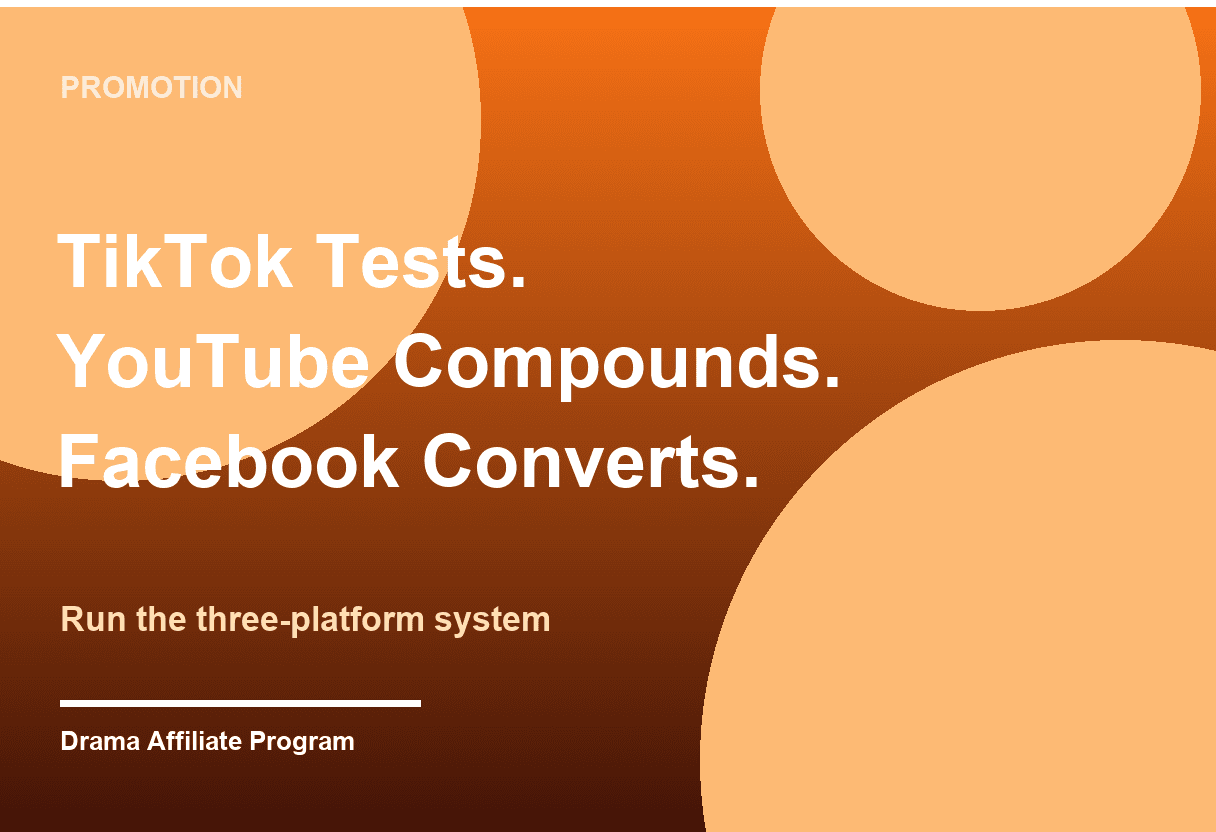
The Three-Platform System: TikTok Tests, YouTube Compounds, Facebook Converts
Stop posting identical clips everywhere - the division of labor where TikTok tests hooks, YouTube Shorts compounds them, and Facebook converts the spending audience.
Most promoters treat TikTok, YouTube Shorts, and Facebook as three copies of the same job — cut a clip, post it three times, hope. That wastes the one structural advantage the format has: each platform fails or rewards a different behavior. Run them as a system with distinct roles and the same footage works three times harder. This guide defines each platform's job, the handoff between them, and the metrics that tell you whether the system is running.
The three roles at a glance
| Platform | Role | What it rewards | Primary metric |
|----------|------|-----------------|----------------|
| TikTok | Testing lab | Speed, volume, strong first-3-seconds | 3-second retention on new hooks |
| YouTube Shorts | Evergreen library | Searchable, specific titles | 30-day view accumulation |
| Facebook | Conversion engine | Older, higher-spending audiences | Referred spending per post |
The system is a pipeline, not a broadcast: test on TikTok, graduate the proven clips to YouTube and Facebook, then read the money metric where the money audience lives. The full reasoning behind per-platform behavior is in the four-platform strategy guide; this page is the operating manual for the division of labor.
TikTok: the testing lab
TikTok's feed gives you the cheapest honest feedback in the business — a new hook either stops the scroll or it does not, within hours. Its job is discovery of what works:
- Post daily; volume is the point, because each clip is a hypothesis.
- Vary one variable per test — hook scene, caption style, or sound — so results mean something.
- Expect most clips to test quietly; you are shopping for the handful of winners that justify the batch.
The testing rhythm, format specs, and caption patterns are detailed in the TikTok promotion guide, and the hook formulas feed the test queue.
YouTube Shorts: the evergreen library
YouTube Shorts behaves less like a feed and more like search with a video box. A clip titled around a specific drama, trope, or question keeps accumulating views for months — which is why its job is not testing but compounding:
- Graduate TikTok winners here with retitled, search-shaped packaging ("[drama name] ending explained," "top revenge short dramas").
- Keep titles specific; vague titles forfeit the search advantage entirely.
- Judge performance on 30-day curves, never on first-day numbers — Shorts often wake up weeks later.
The packaging differences that matter — titles, descriptions, playlists — are covered in the YouTube promotion guide.
Facebook: the conversion engine
Facebook's short-drama audience skews older and more willing to pay for content — the demographic where referred spending concentrates. Its job is turning proven material into commissions:
- Route only tested winners here; this audience forgives less experimentation.
- Post into communities and as Reels; discussion-driven formats (a cliffhanger plus a question) fit the platform's comment culture.
- Watch referred spending per post, not views — a modest view count with strong spending beats a viral clip that converts nobody.
The community formats and posting cadence are detailed in the Facebook & Instagram guide, and the audience contrast behind the strategy is broken down in the demographics guide.
The handoff: from test to library to wallet
The system runs on disciplined handoffs:
- Test on TikTok for a week — identify the top performers by 3-second retention and completion.
- Graduate winners to YouTube Shorts with search-shaped titles, and to Facebook with community-friendly framing. Do not repost the losers.
- Measure where it matters: TikTok tells you what hooks; YouTube shows what compounds; Facebook shows what pays. The analytics guide explains reading each platform's numbers without mixing them.
- Tag everything so the handoff stays measurable — one link scheme per platform, consistent naming, no bare URLs. The UTM attribution guide sets up the scheme.
Common Mistakes in the Three-Platform System
- Posting identical cuts everywhere simultaneously. Identical posts make every platform's data useless — you learn nothing about what the hook did versus what the platform did.
- Judging YouTube by TikTok clocks. A Shorts clip that "only" has 2,000 views in week one may be at 40,000 by week six; killing it early forfeits the compounding.
- Feeding Facebook untested material. The converting audience is the least forgiving; respect it by routing proven clips only.
- Skipping the graduate step entirely. A channel that only tests burns footage forever without ever compounding it — the library and wallet stages are where the testing pays off.
FAQ
Do I need all three platforms from day one? No — start with TikTok alone while you learn to cut hooks, then add YouTube for compounding and Facebook for conversion once you have proven winners to feed them.
How long before a graduated clip shows its YouTube value? Weeks, sometimes longer — Shorts accumulate through search and suggested surfaces. Judge at 30 days and again at 90.
Which platform produces the most referred spending? For most promoters, Facebook — its short-drama audience skews older and more willing to pay, which is why it owns the conversion stage despite lower view counts.
Can the same clip run on all three? Yes, but staged and repackaged: tested on TikTok, retitled for YouTube, community-framed for Facebook — never identical posts at identical times.
Related resources: See current catalog styles on the ReelShort site, and the FTC's endorsement guidance (ftc.gov) applies to disclosures on every platform above.
Keep reading: Who Really Makes Money From Overseas Short Dramas? · ReelShort UTM Attribution
This is an independent channel-docking resource. It is not affiliated with or endorsed by ReelShort.
Email partner@shortdramapartner.com for channel-docking consultation and help applying for your ReelShort invitation code through official channels.
Frequently Asked Questions
How do I get started with The Three-Platform?
Email partner@shortdramapartner.com to request your invitation code. We send your personal code and a step-by-step onboarding link within 24-48 hours.
What is the best platform to promote ReelShort?
TikTok and YouTube Shorts convert best for drama clips, while a blog builds steady long-term SEO traffic. Most top earners combine short video with a written hub.
What type of content actually converts?
High-intent formats - reviews, comparisons, and 'how to watch' guides - consistently outperform random clips because viewers are already looking for the drama.
Can I promote without showing my face?
Yes. Faceless compilation, reaction, and text-overlay formats work well, and many of our top promoters stay completely anonymous.
Want Your Own ReelShort Invitation Code?
You just read how it works — now grab your personal code and start promoting. Enter your email and we'll send it right over.
We'll only use your email to send your invitation code and occasional program updates. No spam.
Comments
Comments powered by Giscus will appear here.