How to Dub Chinese Short Dramas into English with AI
The complete Mandarin-to-English AI dubbing workflow for short-drama promoters: dubbing studio setup, voice assignment, transcript review, and sync fixes.
Dubbing is the step most short-drama promoters skip, and it is easy to see why: re-recording dialogue in English sounds expensive, slow, and technically out of reach for a one-person operation. AI dubbing has quietly changed that math. With a tool like ElevenLabs, you can take a Mandarin-language drama clip and produce an English track where each character keeps a consistent, distinct voice — without booking a studio or a single voice actor. This guide walks through the full workflow we use when localizing Chinese drama clips for English-language platforms, including the decisions that separate a convincing dub from an obvious one.
Why dubbing changes the economics of drama clips
English-speaking viewers on TikTok, Instagram Reels, and YouTube Shorts scroll past foreign-language audio within seconds unless captions carry them. Subtitles solve part of that problem, but they demand constant reading, which raises the effort cost of watching. A dubbed track removes that friction entirely: viewers can listen the way they listen to native content, keep their eyes on the faces, and stay in the story.
The retention impact compounds. Clips with English audio hold viewers through the critical 3-to-10-second window more reliably than subtitle-only clips, and longer watch time is what platform algorithms reward. For promoters working on commission, that difference shows up directly in click-through to the full episode.
Dubbing also unlocks re-use. One Mandarin source clip becomes an English asset, and the same workflow extends to Spanish or Portuguese later. Your editing investment multiplies across markets instead of being locked to one language.
What ElevenLabs actually does in this pipeline
ElevenLabs is an AI audio company built around voice synthesis and dubbing. The features that matter for drama work:
- Dubbing Studio — uploads a video or audio file, transcribes the original speech, translates it, and re-generates each speaker's lines in the target language using matched voice characteristics. Timing is adjusted so lines roughly land where the original did.
- Voice Library — thousands of pre-made voices across ages, accents, and tones, so a cold CEO and a sharp-tongued female lead do not end up sounding like the same narrator.
- Speech synthesis with emotion control — when the auto-translation flattens a line, you can re-render individual segments with adjusted delivery instead of redoing the whole track.
- Multilingual support — English output from Mandarin input works directly; the model handles the translation step, though we always review it (more on that below).
For promoters who only need occasional dubbing, the entry tier is enough to test the workflow on a handful of clips before committing to a higher volume.
The step-by-step Mandarin-to-English dubbing workflow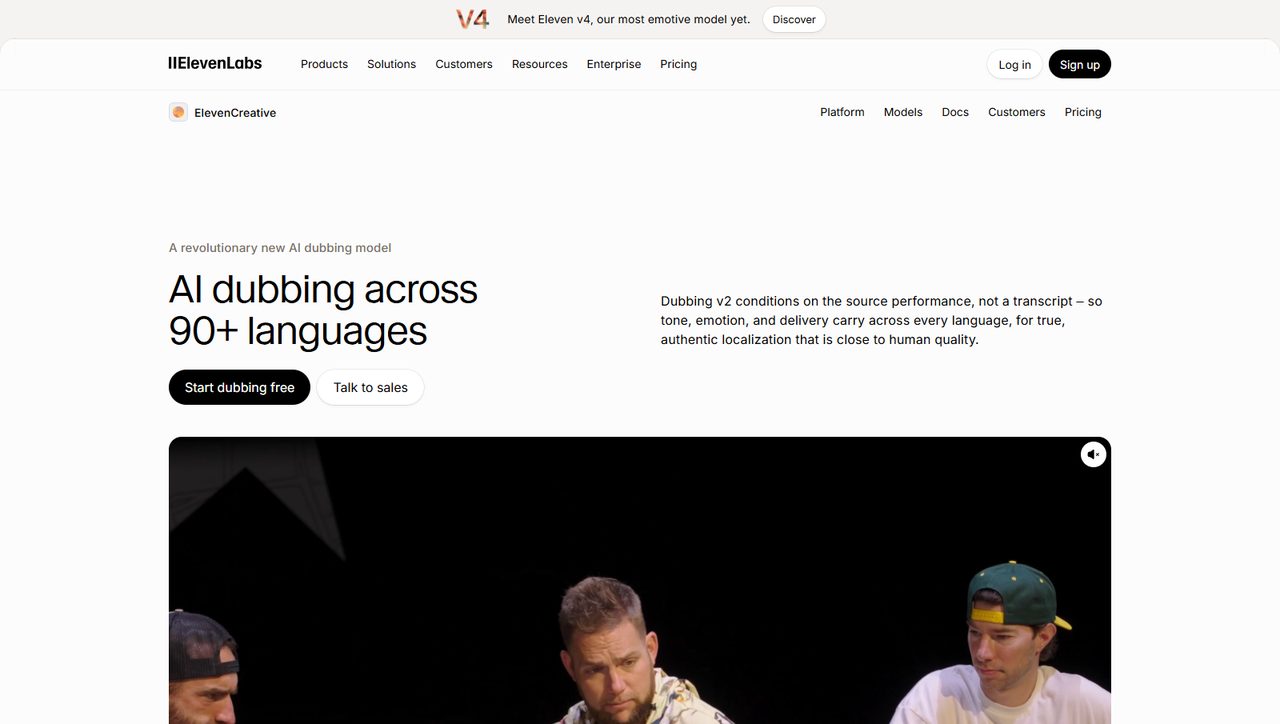
Here is the sequence we follow, refined across dozens of drama clips.
| Step | Action | Watch out for |
|---|---|---|
| 1 | Cut your clip first, dub second | Dubbing a longer cut wastes credits; lock the edit before any audio work |
| 2 | Clean the original audio | Background music bleeding into dialogue confuses transcription |
| 3 | Upload to Dubbing Studio, set source and target language | Double-check Mandarin is detected, not Cantonese |
| 4 | Review the English transcript line by line | Machine translation misses drama-specific phrasing — fix tone, not just grammar |
| 5 | Assign voices per character and render | Pick voices from the library that contrast clearly; test one scene first |
| 6 | Export, re-sync against the picture, and adjust | Lip-sync will not be perfect; prioritize pacing over frame accuracy |
Step 4 deserves emphasis. The translation model handles everyday dialogue well, but drama scripts are dense with idioms, status-laden address terms, and emotionally loaded short lines. A line like a formal title or a pointed insult often lands flat in direct translation. We rewrite those lines in the transcript editor before rendering — keeping them short enough to fit the original timing, which is the real constraint.
On voice assignment: use two or three clearly distinct voices per clip, and reuse the same assignment across clips in the same series. Viewers who binge a series notice when the male lead's voice changes between episodes, and inconsistency breaks the illusion faster than imperfect sync ever will.
Sync, pacing, and the honesty question
Perfect lip-sync is not the goal — nobody expects a machine dub to match mouth movements frame by frame, and audiences accept this convention readily. What matters is pacing: the English line should start near when the mouth starts and end near when it stops. When a translated line runs long, shorten it rather than slowing the audio, because stretched audio sounds robotic and slow pacing kills retention.
There is also a rights question, and it comes before any editing choice. Dubbing is a transformative edit of someone else's content. Only use material you are authorized to promote — official promotional assets, platform-provided creative, or content you produced yourself. Fingerprint detection on major platforms is increasingly effective, and a striking dub will not save an account that keeps uploading content it has no right to use. We cover the authorization basics in Promotional Assets Guide and How to Get a ReelShort Invitation Code.
Cost logic: when dubbing pays for itself
ElevenLabs pricing is subscription-based, tiered by monthly character volume. The practical way to think about it: a 60-second drama clip with dense dialogue might consume a few thousand characters of audio generation after retries and re-renders. If your workflow produces ten clips a month, the entry tiers cover testing; production volume pushes you up a tier.
The decision rule is simple. Dub only after your clip workflow is already converting — if your subtitled clips get clicks, dubbing is an upgrade with measurable upside. If they do not, dubbing is a cost without a baseline to compare against. Sequence matters: cut, caption, publish, measure, then dub the proven winners. This mirrors the pricing logic we laid out in Opus Clip vs Vizard for Short Drama Promotion — pay for a tool at the stage where its output compounds, not before.
Common Mistakes when dubbing Chinese dramas into English
Dubbing before the edit is locked. Every re-cut invalidates the dub. Lock your cut, then produce audio.
Letting the machine translation ship unreviewed. Auto-translation handles grammar, not drama. Formal address, sarcasm, and threats lose their edge and the clip loses its tension. Budget ten minutes of transcript review per minute of video.
One narrator voice for every character. It saves setup time and costs you immersion. Assign distinct voices, even in two-character scenes.
Ignoring the original music bed. Drama scores carry emotion. Either keep the original music low under the dub or replace it; a dub that sits on top of a full-volume original track sounds like chaos.
Dubbing clips that never converted with subtitles. Dubbing is an amplifier, not a fix. Prove the cut works first, then amplify it.
FAQ
How accurate is ElevenLabs dubbing from Mandarin to English?
Transcription of clear dialogue is strong; translation is good but needs human review for drama-specific phrasing. Voice matching is convincing for tone and age, though it will not replicate a specific actor's voice.
Do viewers notice it is AI audio?
Usually not if pacing is right and voices are consistent. What gives it away is slow, stretched audio and flat emotional delivery — both fixable in review.
Can I dub without knowing any English editing terms?
The Dubbing Studio interface is straightforward: upload, pick languages, review the transcript, render. The workflow in this guide requires no audio engineering background.
How long does one clip take to dub?
A 60-second clip takes roughly 20 to 40 minutes including transcript review, voice assignment, and one round of sync adjustments. The first clip is slower; subsequent clips in the same series reuse voice assignments.
Is AI dubbing allowed on TikTok and YouTube Shorts?
Yes, provided you have rights to the underlying content and label synthetic media where the platform requires it. Both platforms require disclosure for realistic AI-generated content in some contexts — check current policies before publishing.
Verdict
AI dubbing used to be a studio capability; it is now a subscription feature. For promoters running Chinese-language drama content into English markets, ElevenLabs is the practical choice because it handles the full chain — transcription, translation, and per-character voice rendering — in one place. Start with your two or three highest-performing subtitled clips, review the translated transcript carefully, keep voice assignments consistent across a series, and treat the dub as an upgrade to proven material rather than a rescue for weak cuts.
Related reading: Promoting Short Dramas Without English Content · The Editor-Only Path to Short Drama Promotion · SubMagic Review: Drama Captions · Short Drama Hook Formulas · AI Editing Tools Roundup · Your First Short Drama Commission Timeline
Some links in this guide are affiliate links — we may earn a commission at no extra cost to you, and this never affects our verdicts.
This is an independent channel-docking resource. It is not affiliated with or endorsed by ReelShort or any tool reviewed above.
Email partner@shortdramapartner.com for channel-docking consultation and help applying for your ReelShort invitation code through official channels.
Frequently Asked Questions
How do I get started with How to?
Email partner@shortdramapartner.com to request your invitation code. We send your personal code and a step-by-step onboarding link within 24-48 hours.
How do I join the ReelShort affiliate program?
Email partner@shortdramapartner.com with your name, your promotion channels (TikTok, YouTube, blog, etc.), and an estimate of your monthly traffic. We reply within 24-48 hours with your personal invitation code and registration link.
Do I need any experience to start?
No. Our free guides walk you through every step - from getting your code to publishing your first promo post - so complete beginners can follow along.
How soon can I earn my first commission?
Most new affiliates see their first conversions within 2-4 weeks of consistent daily promotion.
Want Your Own ReelShort Invitation Code?
You just read how it works — now grab your personal code and start promoting. Enter your email and we'll send it right over.
We'll only use your email to send your invitation code and occasional program updates. No spam.
Recommended Tools
Tools our team actually uses to produce and promote short drama clips.
- Opus ClipTurn long drama episodes into scroll-stopping shorts automatically
- SubMagicAuto-captions, emojis and b-roll for short-form video
- ElevenLabsAI voiceovers — dub Mandarin drama clips into natural English
- VizardTurn long recordings into short social clips with transcripts
- GetResponseEmail marketing to grow your own promo audience
- Systeme.ioFree funnels, email and automation for affiliate beginners
Some links above are affiliate links — we may earn a commission at no extra cost to you. This never affects our rankings or recommendations.
Comments
Comments powered by Giscus will appear here.